


The Stories We Tell Ourselves: Moving from Pessimism to Optimism
Have you ever noticed that two people can experience the exact same setback and walk away with completely different conclusions? One person sees a challenge and thinks, "That was frustrating, but I'll figure it out." The other thinks, "This always happens to me." The event may be the same, but the story they tell themselves about the event is very different.
Psychologist Dr. Martin Seligman spent much of his career studying these differences. Through his work in positive psychology, he found that optimism and pessimism are less about what happens to us and more about how we explain what happens to us. He called this our explanatory style, and it can have a powerful impact on our resilience, motivation, and overall well-being.
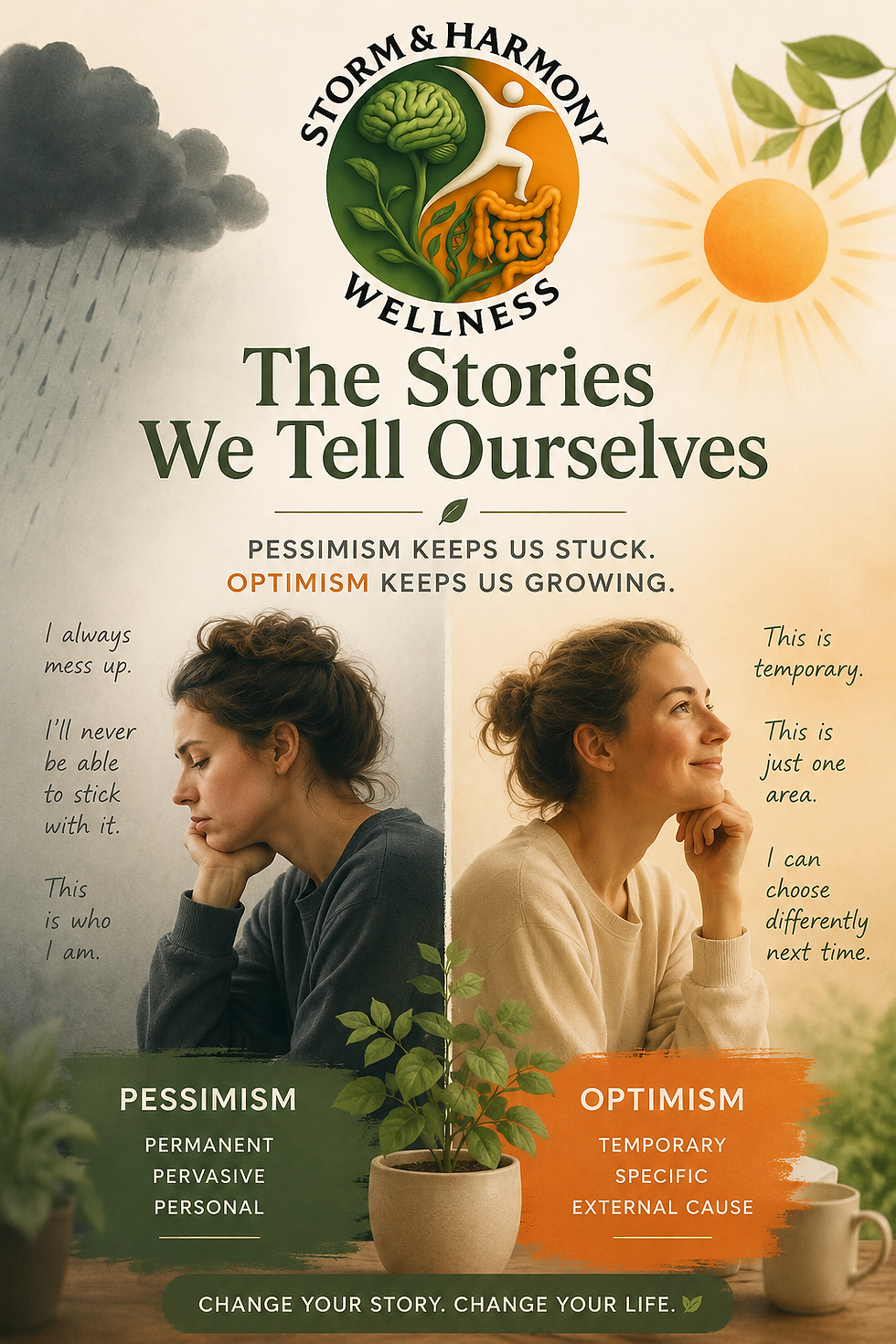
Many people think optimism means always looking on the bright side and pretending everything is okay. I don't think that's necessarily true. There are times when a more pessimistic outlook can be helpful. It can help us identify risks, prepare for challenges, and avoid repeating mistakes. The problem isn't pessimism itself. The problem is when our internal dialogue becomes so automatic that we begin accepting our interpretations as facts.
I see this often when people are working toward health goals. Imagine someone has committed to improving their nutrition, exercising consistently, and prioritizing sleep. Things are going well for a few weeks. Then work becomes stressful, the kids have activities every night, workouts are missed, and convenience foods start showing up more often than planned.
For some people, the internal dialogue quickly turns harsh.
"Here we go again. I always mess this up. I have no discipline. I'm never going to get healthy."
What is interesting is that a single difficult week suddenly becomes much bigger than it actually is. The setback feels permanent. It feels pervasive. It feels personal. One challenge becomes evidence that there is something fundamentally wrong with the person.
An optimistic perspective doesn't ignore the setback. Instead, it interprets it differently.
"That wasn't my best week. Things got busy, and I drifted away from some of the habits I was building. I'm disappointed, but I can get back on track this week."
The circumstances are acknowledged. The frustration is acknowledged. But the setback remains temporary and specific rather than becoming a judgment of character.
This is where Seligman's work becomes particularly interesting. He found that optimists and pessimists tend to explain both good and bad situations differently. When something positive happens, optimists often see it as personal. They recognize their effort and contribution. They are more likely to think, "I worked hard for this," or "My choices helped create this outcome."
Pessimists often do the opposite. They may explain success as luck, timing, or coincidence. They discount their role in the achievement and struggle to fully own their accomplishments.
When something negative happens, the pattern reverses. Optimists are more likely to view the challenge as temporary and limited to a specific situation. Pessimists often see it as permanent, affecting multiple areas of life, and reflective of who they are as a person.
The good news is that these thought patterns are not fixed. We can learn to challenge them.
When you catch yourself feeling discouraged, it can be helpful to pause and ask a few simple questions. Is this situation truly permanent, or is it temporary? Is this affecting every area of my life, or just one area? Am I taking responsibility for everything, or are there other factors that contributed to this outcome?
Those questions may seem simple, but they create space between an event and the story we tell ourselves about it.

At Storm & Harmony Wellness, we often talk about nutrition, movement, sleep, and stress management. Those things matter. But underneath all of those habits is something equally important: the conversation happening inside our own minds. The stories we tell ourselves influence whether we keep moving forward or decide to give up.
The goal is not blind positivity. The goal is accuracy. A missed workout does not erase months of progress. One stressful week does not define your health journey. A setback is simply a setback. Sometimes the most powerful thing we can change is not our circumstances, but the story we tell ourselves about them.
Reference
Kok-Mun Ng, A. (2019, March 11). What are attributional and explanatory styles in psychology? PositivePsychology.com.


Comments